Why Payment Receipt Data Is Still a Manual Problem for Many Businesses
Payment receipts contain useful financial information, but getting that information into business systems can still require manual work. This article explores how OCR can simplify receipt data extraction and fit into automated financial workflows.
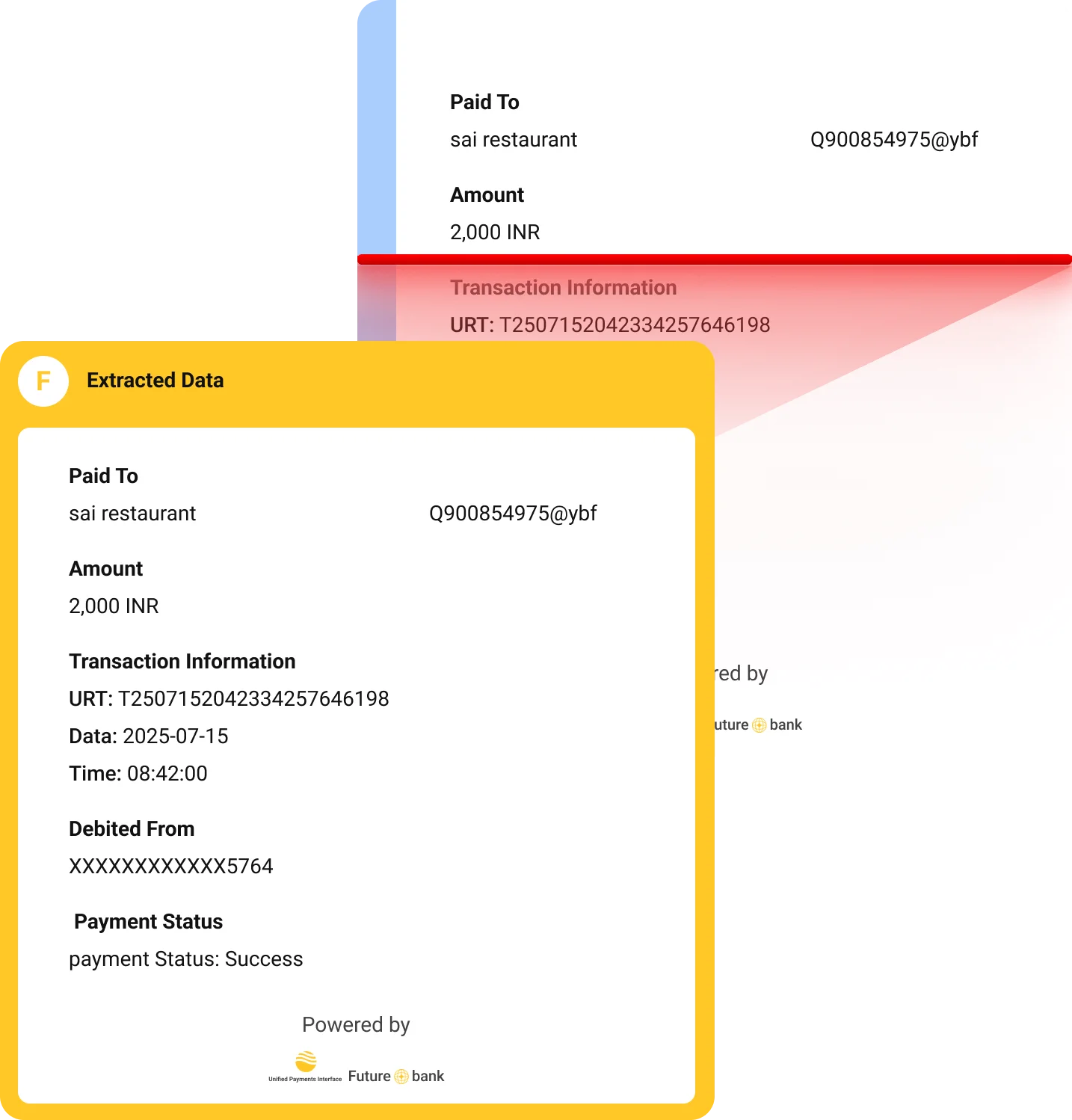
The information is already visible. There is usually an amount, date, payment status, reference information, and other details that a business may need to keep for its records.
The problem is getting that information from the receipt into the system where it is actually needed.
A receipt may arrive as a screenshot from a payment application, a scanned image, or a PDF. Someone then has to open it, read the relevant information, and enter those details into another application.
When there are only a few receipts, this doesn't seem like a serious problem. But repetitive tasks become more noticeable as the volume of documents increases.
The Gap Between Reading and Processing
People can usually understand a payment receipt immediately. Software needs the information in a format that it can process.
This creates an interesting gap between information that is visible and information that is usable by software.
OCR can help bridge that gap.
Optical Character Recognition allows software to read information contained in images and documents. When this capability is exposed through an API, developers can connect document processing with applications that already handle financial or business workflows.
The AZAPI Payment Receipt OCR API is designed around this idea.
Depending on the receipt, it can extract information such as:
Recipient or payee name
UPI ID
Payment amount
Currency
Transaction ID
UTR number
Payment status
Date and time
Source payment application, where available
Masked account or card information, where available
The extracted information can then be used by another part of the application instead of requiring someone to manually copy each field.
Where This Can Make a Difference
Receipt extraction can become useful in several everyday business processes.
For example, an accounting system may need payment information when maintaining financial records. A reconciliation workflow may need reference numbers and amounts to compare incoming records. A financial application may need to capture information from receipts submitted by users.
The same concept can also be useful for expense management, payment tracking, internal dashboards, and other applications where receipt information needs to be recorded.
The important part is not simply recognizing text.
The extracted information needs to become useful to the application that receives it.
Why Small Automation Improvements Matter
Business automation is often associated with large and complex systems. But many useful improvements start with much smaller problems.
Removing one repetitive task from a workflow may not seem significant at first. However, when that task is repeated hundreds of times, the accumulated effort can become substantial.
Payment receipt processing is a good example.
Instead of manually reading every receipt, an application can use an OCR service to extract the available information and then decide what should happen next.
The data could be stored, validated, displayed to a user, compared with another record, or passed into an existing business process.
Building Around Existing Workflows
For developers, adding document processing to an application can involve more than simply recognizing text. The system also needs to handle uploaded documents, identify relevant fields, process the extracted information, and connect the result with existing application logic.
An API can provide an integration layer for this process.
Rather than making OCR the main focus of an accounting platform, payment application, or internal business tool, developers can use an OCR API as one component within the larger workflow.
This makes document processing easier to incorporate into applications where payment receipts are only one part of the overall system.
A Practical Use of OCR
The goal of OCR in this situation is not to make payment processing more complicated. It is to remove an unnecessary manual step.
A payment receipt already contains information that businesses may need. The challenge is making that information accessible to software in a structured way.
That is where a Payment Receipt OCR API can be useful.
At AZAPI, we are exploring practical OCR and document automation use cases where information inside everyday business documents can be converted into data that applications can work with.
For developers interested in adding receipt data extraction to their workflows, more information about the service is available on the AZAPI Payment Receipt OCR API page:
https://azapi.ai/services/ocr/payment-receipt-ocr-api/
Publication Review Code
Authors with 10+ approved publications in Technology can rate this article as Valid or Tidak Valid. Each valid rating from a qualified reviewer adds points toward this article's community badge.
Enter your email to verify your reviewer eligibility for this category.
Published on Onesty — a research & publishing platform by Ruswanda Clarck. Part of a verified professional network: ruswanda.my.id · hikcctvmedan.com · onesty.my.id